

Content Pillars That Make Posting Easier

You chose your content pillars. Education. Behind the scenes. Motivation. Personal.
Great. Now it is Tuesday morning, you need to post something, and those four words are doing absolutely nothing to help.
That is where most content pillar advice falls apart. It gives you a few broad buckets, tells you to rotate through them, and sends you on your way. You still have to figure out what to say, who it is for, and how any of it connects to the service you want people to hire you for.
Useful content pillars should make those decisions easier. They should give your content direction without trapping you inside a rigid schedule or forcing you to create the same post every week.
If your current pillars feel vague, random, or disconnected from your offers, this guide will help you rebuild them into something you can actually use.
What Are Content Pillars?
Content pillars are the main topics you return to repeatedly in your marketing. They connect what your audience needs to understand with what you know, believe, and offer.
For a Virtual Assistant, content pillars might cover the problems your clients face, the way you solve those problems, evidence that you can do the work, and the point of view that makes your approach different.
They are not individual post ideas. They are the larger lanes that hold those ideas.
Think of the difference this way:
- Pillar: Client onboarding
- Post idea: Five items to collect before a client kickoff call
- Format: Carousel
- Goal: Help a potential client understand the value of a structured onboarding process
The pillar tells you what territory you are in. The post idea tells you what to say. The format determines how you package it. The goal keeps the content from becoming another random tip floating around the internet.
Why Most Content Pillars Do Not Help
The usual advice is to choose three to five topics you enjoy talking about. That sounds reasonable until all five topics appeal to other VAs, none of them support your services, and you wonder why your content is not bringing potential clients any closer.
Common problems include:
The pillars are too broad
“Education” is not a topic. It describes what the content does. You could educate someone about social media, bookkeeping, gardening, or how to stop your dog from stealing socks.
The same is true for inspiration, storytelling, and promotion. Those are approaches or purposes, not useful topic lanes by themselves.
The pillars were copied from someone else
A content strategist, email marketing VA, and executive assistant should not have identical pillars just because a popular creator shared a template.
Your pillars need to reflect your services, audience, experience, and opinions.
Every pillar teaches but none sells
Educational content can build trust, but endless tips may train people to collect your advice without understanding why they should hire you.
Your content also needs to demonstrate your process, show evidence, explain your standards, and connect the problem to the service you provide.
The personal pillar has no direction
Personal content can help people connect with you. It does not mean your coffee, dog, weekend errands, and Tuesday mood each need their own strategic lane.
Share personal stories when they reveal something relevant about how you think, work, communicate, or run your business. Your personality should show up throughout your content, not live inside one lonely bucket labeled “personal.”
A Practical Content Pillar Framework for VAs
You do not need seven complicated strategies. Start with four useful pillars:
- Problems
- Process
- Proof
- Perspective
These cover what your audience is dealing with, how you help, why they should trust you, and what makes your approach yours.
Pillar 1: Problems Your Clients Want Solved
This pillar covers the frustrations, gaps, and consequences your potential clients already recognize.
Do not stop at naming the service. “Email marketing” is broad. “New subscribers join the list and hear nothing for three months” is a real problem.
Examples for different VA services include:
- A business owner is posting inconsistently because there is no content plan.
- New client information is scattered across email, DMs, and handwritten notes.
- A welcome sequence is outdated or does not exist.
- Leads are not being followed up with consistently.
- The website looks fine on desktop but falls apart on mobile.
- The owner is spending hours completing work that could be documented and delegated.
Content in this pillar helps the right person recognize a problem, understand its cost, and see that a better way exists.
Possible post angles include mistakes, warning signs, overlooked consequences, common questions, and what to fix first.
Pillar 2: Your Process and Expertise
Potential clients do not only need to know what you do. They need to understand how you think and what it is like to work with you.
This pillar shows the decisions, standards, tools, and steps behind your service without giving away every detail of the work.
A social media VA might share:
- How content moves from idea to approval to scheduling
- What is included in a monthly analytics review
- Why brand voice comes before writing captions
- How client feedback is collected without 47 emails
An email marketing VA might share:
- What gets checked during an email audit
- How subscribers are organized by interests or behavior
- What belongs in a welcome sequence
- Why an email should be tested before it is scheduled
A systems or operations VA might share:
- How a messy workflow becomes an SOP
- What to document before delegating
- How a client portal reduces scattered communication
- The difference between adding another tool and improving the process
Process content demonstrates competence. It also helps potential clients understand that they are not paying you to click buttons. They are paying for the thinking, judgment, and structure behind the result.
Pillar 3: Proof That Builds Trust
Proof content answers a quiet question every potential client has: Can this person actually do what she says she can do?
Use real evidence. Do not invent Sarah, Janna, or Emily and give them imaginary results. If you do not have a polished case study yet, you still have honest options.
Proof can include:
- Client testimonials
- Before-and-after examples
- Screenshots with private information removed
- A walkthrough of a completed project
- Lessons from your own business systems
- A client-approved result or metric
- A sample you created and clearly label as a sample
- A description of a problem you solved without identifying the client
Be specific whenever possible. “The client loved it” is pleasant. “We replaced email approvals with one ClickUp workflow, so the team could see every revision and deadline in one place” explains what changed.
Proof does not have to mean a dramatic revenue claim. Better organization, faster decisions, clearer communication, fewer missed steps, and a smoother client experience are valuable outcomes.
Pillar 4: Your Perspective
Your perspective is where your standards, beliefs, boundaries, experience, and personality become part of the strategy.
This is what keeps your content from sounding like it was pulled from the same template as everyone else’s.
Examples include:
- Why posting more often is not always the answer
- Why you will not begin work without a signed contract
- Why a new tool cannot repair a broken process
- What you believe clients should expect from a VA relationship
- A lesson you learned after handling a project differently than you would today
- An industry practice you disagree with and what you recommend instead
Perspective content should still be useful to the audience. A random opinion may get attention, but a relevant opinion helps someone understand whether they trust your approach.
You do not need to manufacture a hot take every week. Share what you genuinely believe and explain the reasoning behind it.
Where Does Promotional Content Belong?
Promotion does not need to be a separate pillar that appears once every six weeks when you finally work up the nerve to mention your offer.
Your service can connect naturally to every pillar:
- A problem post can explain what happens when the issue is ignored and how your service helps.
- A process post can show what is included when someone hires you.
- A proof post can demonstrate the result of your work.
- A perspective post can explain the standards behind your offer.
Not every post needs a sales pitch. Every pillar should, however, have a reasonable path back to what you do.
If a pillar can never connect to your audience’s needs, your expertise, or your offers, ask why it is part of the business strategy.
How to Build Your Content Pillars
Set aside 30 minutes and follow this process. Do not begin by searching Pinterest for someone else’s list.
Start with the service you want to sell
Choose one primary service or offer. If you try to build pillars around six unrelated services at once, the content will become just as scattered as the business.
Write down:
- What the service does
- Who it helps
- What problem creates the need for it
- What changes after the work is completed
- What makes your approach different
List the questions and problems you hear
Look through inquiry forms, discovery-call notes, client emails, comments, DMs, and community conversations. Use the language real people use.
If you are newer and do not have many client conversations yet, review questions asked in legitimate industry communities. Do not copy another creator’s answers. Pay attention to the problems and wording.
Sort the ideas into the four pillars
Place each idea under Problems, Process, Proof, or Perspective. Some ideas could fit more than one, which is fine. Choose the lane that matches the point you want the post to make.
Give each pillar three to five subtopics
Your pillars become much more useful when they contain smaller repeatable themes.
For example, a social media VA might use:
| Pillar | Possible subtopics |
|---|---|
| Problems | Inconsistent posting, unclear messaging, weak engagement, approval delays |
| Process | Strategy, content planning, caption writing, scheduling, analytics |
| Proof | Client feedback, workflow improvements, content examples, reporting insights |
| Perspective | Trends versus strategy, boundaries, quality versus volume, realistic expectations |
Now “What should I post?” becomes a smaller question. You are choosing from a useful list instead of staring into the void.
Turn One Pillar Into Multiple Posts
You do not need a brand-new subject every time you publish. One subtopic can become several posts by changing the angle.
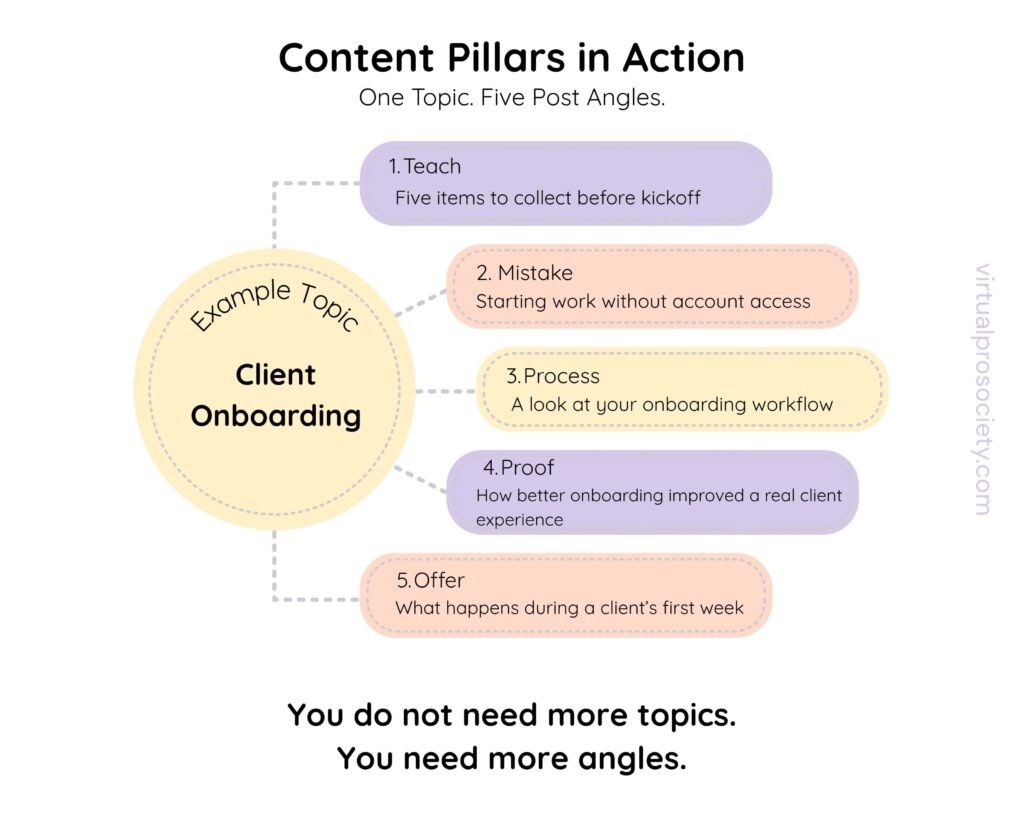
Suppose your pillar is Process and the subtopic is client onboarding.
You could create:
- Teach: Five items to collect before the kickoff call
- Identify a mistake: Why starting work before receiving access creates delays
- Show the process: A simple look at your onboarding workflow
- Share proof: How a centralized onboarding system improved communication on a real project
- Connect the offer: What your client receives during the first week of working with you
That is five useful posts from one subtopic. Repeat the exercise across your pillars and you have a content bank without inventing 100 unrelated ideas.
This is especially helpful for an ADHD brain. The structure reduces decisions, but there is still enough flexibility to follow a timely idea or change the format when you are bored.
Content Pillars Are Not a Posting Schedule
You do not have to post each pillar on a specific weekday or distribute them perfectly.
Your audience does not know that Tuesday was supposed to be a proof post. They are not standing by with a clipboard waiting to see whether you followed the spreadsheet.
Use your pillars as a guide, not a set of handcuffs.
If you are promoting a service, your problem, process, and proof content may appear more frequently for a few weeks. If an industry change affects your clients, your perspective pillar might take the lead.
The goal is consistency of message, not a perfectly even rotation.
How Many Content Pillars Do You Need?
Most VAs can work comfortably with three to five. Sprout Social also recommends keeping a social media strategy to roughly three to five content pillars so the brand’s message does not become diluted. I recommend starting with four because the Problems, Process, Proof, and Perspective framework covers the essential jobs your content needs to do without becoming difficult to manage.
More pillars do not automatically create more variety. They can create more decisions, overlap, and abandoned lists.
If your business has two closely related services, they may fit under the same pillars with different subtopics. If the audiences and offers are completely different, they may need separate content strategies or even separate platforms.
Do not add another pillar because you posted a photo of your dog once. Ruby would never demand that kind of administrative overhead.
Review Your Pillars Without Starting Over
Give the system enough time to produce useful information. Review your content every 60 to 90 days instead of replacing the pillars after three posts.
Look for:
- Topics that generate saves and shares
- Posts that lead to profile visits
- Questions people ask in comments or DMs
- Content that attracts potential clients instead of only peers
- Posts that naturally lead into your services
- Pillars you avoid because they are too vague or difficult to support
Pay attention to the goal of the post. Proof content may not receive the most likes, but it could build trust with the person quietly deciding whether to contact you.
Adjust subtopics before replacing an entire pillar. Sometimes the lane is right and the post angles need work.
Signs Your Content Pillars Need Work
Revisit your strategy if:
- You still cannot think of specific post ideas.
- The pillars do not connect to your services.
- Most of your engagement comes from peers when you want clients.
- Every post teaches but none demonstrates your process or proof.
- You are speaking to several unrelated audiences.
- The topics could belong to almost any business.
- Your content sounds polished but does not sound like you.
Content pillars should reduce confusion. If they create another complicated system to maintain, simplify them.
Build Pillars That Support the Business
Your content does not need seven clever categories or a perfectly color-coded calendar.
Choose repeatable topics that help your audience recognize a problem, understand your process, trust your ability, and connect with your perspective. Build a few subtopics under each one. Then reuse those ideas from different angles.
The best content pillars make the next useful post easier to create while keeping the work connected to the business you are trying to build.
Want the Planning Part Handled?
Inside Virtual Pro Society, Virtual Assistants get weekly content prompts, Canva templates, and practical AI tips that make it easier to create content without starting from a blank screen every time.
Choose your lanes. Build the bank. Post the damn thing.

